5-Minute Fact Fluency
Introduction
We hear it all the time - “my students just can’t remember their math facts.”
You’ve tried flash cards, skip counting, and centers, but your students are still using their fingers, drawing arrays, and struggling to automatically recall their basic facts.
Sure, students can solve 7 × 8 but when they’re making equivalent fractions, dividing multi-digit numbers, and solving proportions, inefficient strategies like counting fingers, skip counting, and drawing circles can lead to frustration and mistakes.
Why can’t they just remember?
The problem is that many curriculum programs only prioritize conceptual understanding of the four operations but don’t provide the practice or repetition students need to commit the basic facts to memory.
The good news is that students can build conceptual understanding and memorize their math facts. We’ve seen it happen in our classrooms and we know it can work in yours.
In this guide, we explain why memorizing math facts is still important and share the routine that we use in our classrooms to help students reach automaticity.
Table of Contents
What’s the Difference Between Fluency & Automaticity?
Why Is Automaticity Important?
The 5-Minute Fluency Routine
Results - Does It Work?
Materials
FAQS
Key Takeaways
What’s the Difference Between Fact Fluency & Automaticity?
Fact fluency is the ability to quickly and accurately recall addition, subtraction, multiplication, and division facts using conceptual understanding, strategy use, and memorization.
Automaticity means students recall facts in two seconds or less. They just know it. When students can complete 30-40 problems in 60 seconds, retrieval is automatic.
Research shows math fact automaticity predicts overall mathematics performance (Stickney et al., 2012). Information-processing theory explains why: without direct retrieval, working memory overloads and accuracy drops (Woodward, 2006).
Why is Automaticity Important?
Automaticity is important because it reduces cognitive load. When students must skip count or use other strategies to derive basic facts, they consume valuable cognitive space. That leaves less capacity for:
Multi-step problems
Fraction operations
Algebraic reasoning
Word problem comprehension
Working memory has limited capacity while long-term memory does not. Automaticity transfers facts into long-term memory for instant retrieval.
This frees up more space for students to think and solve more complex problems.
The concept of automaticity is critical for the general success of students in mathematics. There are studies that have found math fact automaticity to be a predictor of performance on general mathematics tests (Stickney et al., 2012).
The 5-Minute Fluency Routine (Daily Structure)
The Proficiency Project Fluency routine is a daily program that consists of two 1-minute timed intervals where students answer as many math facts as possible. Daily implementation ensures that the routine is predictable, low-stakes, and focused on growth.
How It Works:
Each week, students practice a new fact family. DO NOT introduce new facts daily.
Teachers maintain a low-stakes, fun environment.
Monday - Thursday: Students complete two 1-minute practice rounds. Unanswered problems are taken home for homework.
Friday: Students complete one 1-minute interval and compare their progress to the beginning of the week.
Daily Implementation - Minute by Minute Breakdown
Teachers pass out the fluency worksheet. Before beginning, remind students that this is not a test. Their goal is to challenge themselves and do better than they did before.
Minute 1: Cold Test (60 seconds)
Teacher: Set a timer for 1-minute.
Students complete as many problems as possible in one minute.
When time is called, pencils go down. (Don’t have students check their answers yet!)
Minute 2: Whole-Class Choral Response
Teacher: Display the answers on the board so that all students can see.
Students recite the facts together:
“1 × 10 = 10
2 × 10 = 20
3 × 10 = 30…”
Choral response reinforces accurate retrieval without isolating individual students.
Minute 3: Check and Record
Students:
Cross out incorrect answers
Rewrite the correct fact under mistakes
Record total correct
Teacher: Walk around the classroom to ensure students are checking for errors. Immediate feedback prevents errors from hardening into habits. Don’t forget to take answers down before the second round.
Minute 4: Hot Test (60 seconds)
Teacher: Set a timer for 1-minute.
Students attempt the same facts again with the goal of improving their score.
When time is called, pencils go down.
Minute 5: Recite, Check, and Celebrate!
Answers are revealed again.
Students recite facts chorally.
They cross out errors, rewrite correct answers, and record their final score.
Teacher: Celebrate progress! No amount of growth is too small to celebrate.
If students do not complete both sides of the worksheet during practice, it becomes homework for additional practice.
Results - Does It Work?
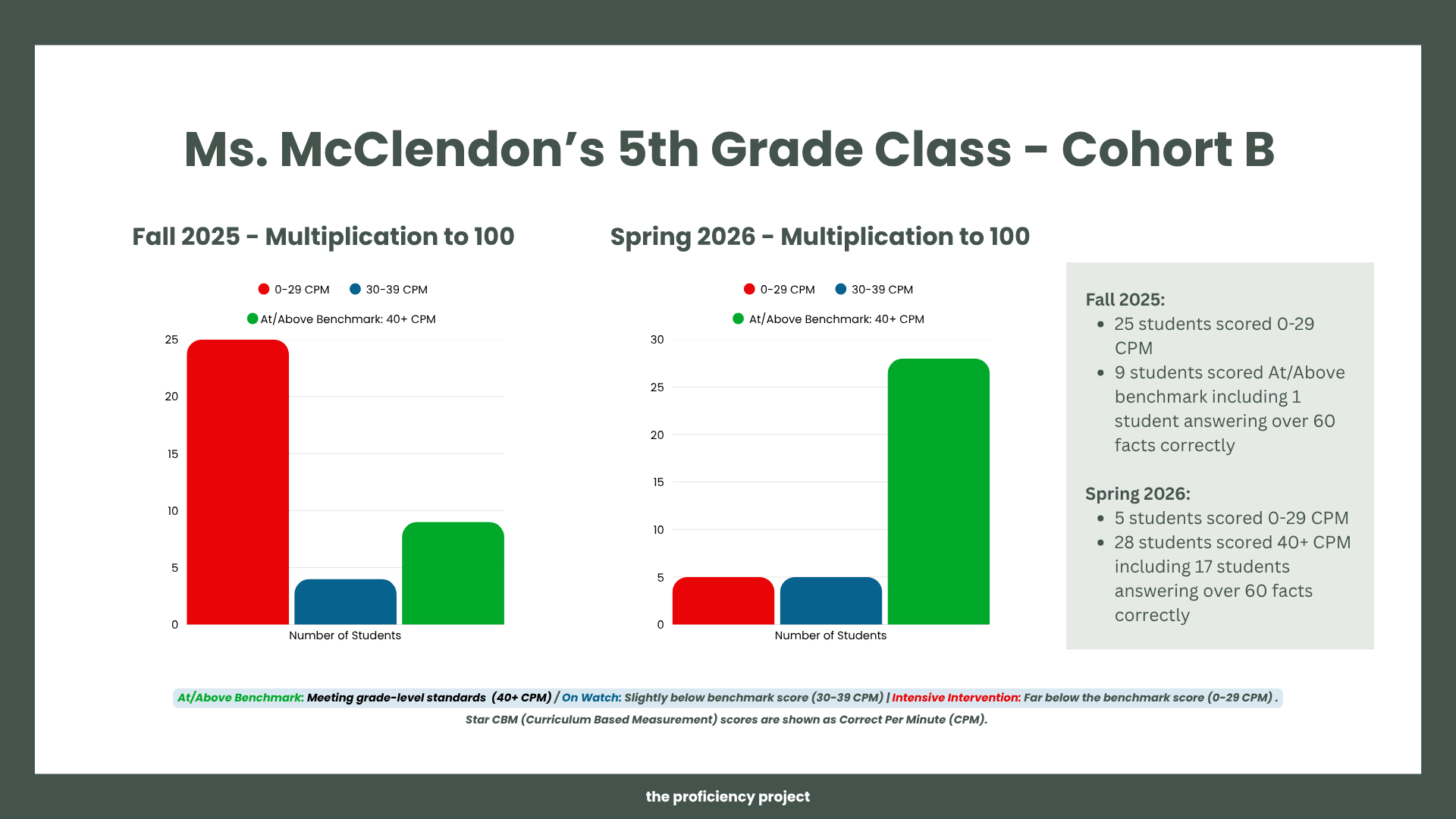
During the 2025-2026 school year, only 9 of Takia’s 44 students could correctly recall 40 multiplication facts in 1-minute. This gap in automaticity led to unnecessary struggles with 5th grade content like multi-digit multiplication/division problem-solving as well as fraction operations.
Using The Proficiency Project Fact Fluency Routine, students practiced their multiplication and division facts daily. As a result, the number of students who were able to score 40 CPM (correct per minute) tripled throughout the school year. Review her students’ progress below.
Highlights
In the fall, 25 students recalled less than 30 multiplication facts/minute. By the end of the school year, that number dropped to 5 students.
In the fall, only 9 students were able to recall 40+ multiplication facts/minute. In the spring, that number grew to 28 students.
By the end of the school year, 17 students were able to answer over 60 multiplication facts/minute.
Materials
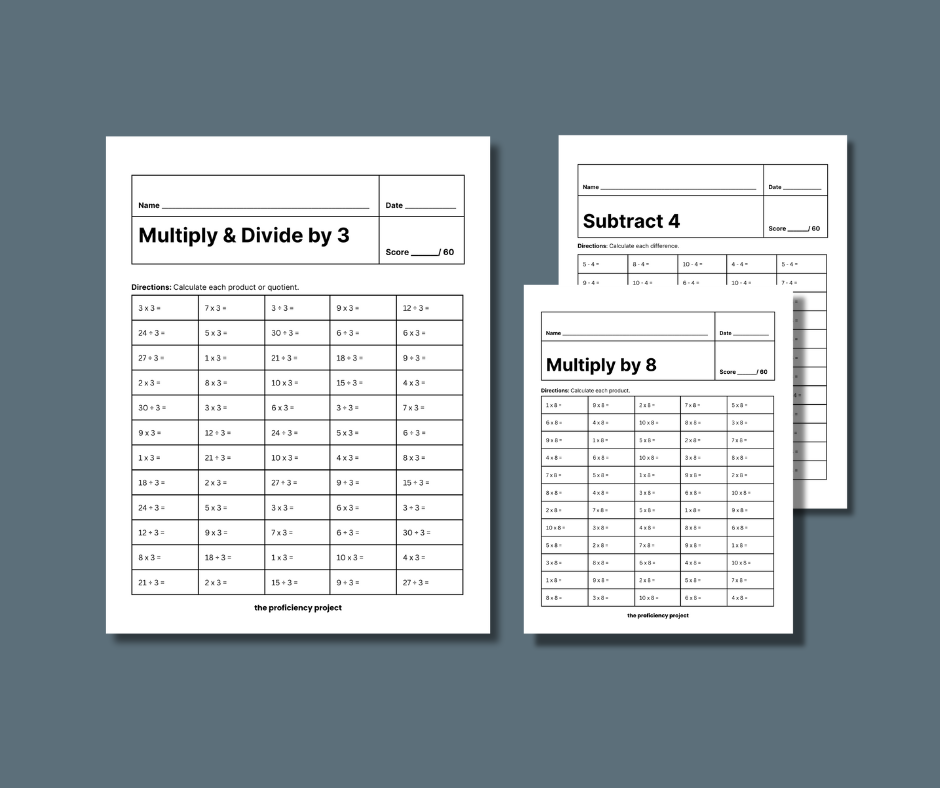
Ready to implement the program in your classroom? Fluency worksheets are currently available in subtraction, multiplication, division, and mixed multiplication/division.
Addition within 10 (Coming Soon)
How It Works
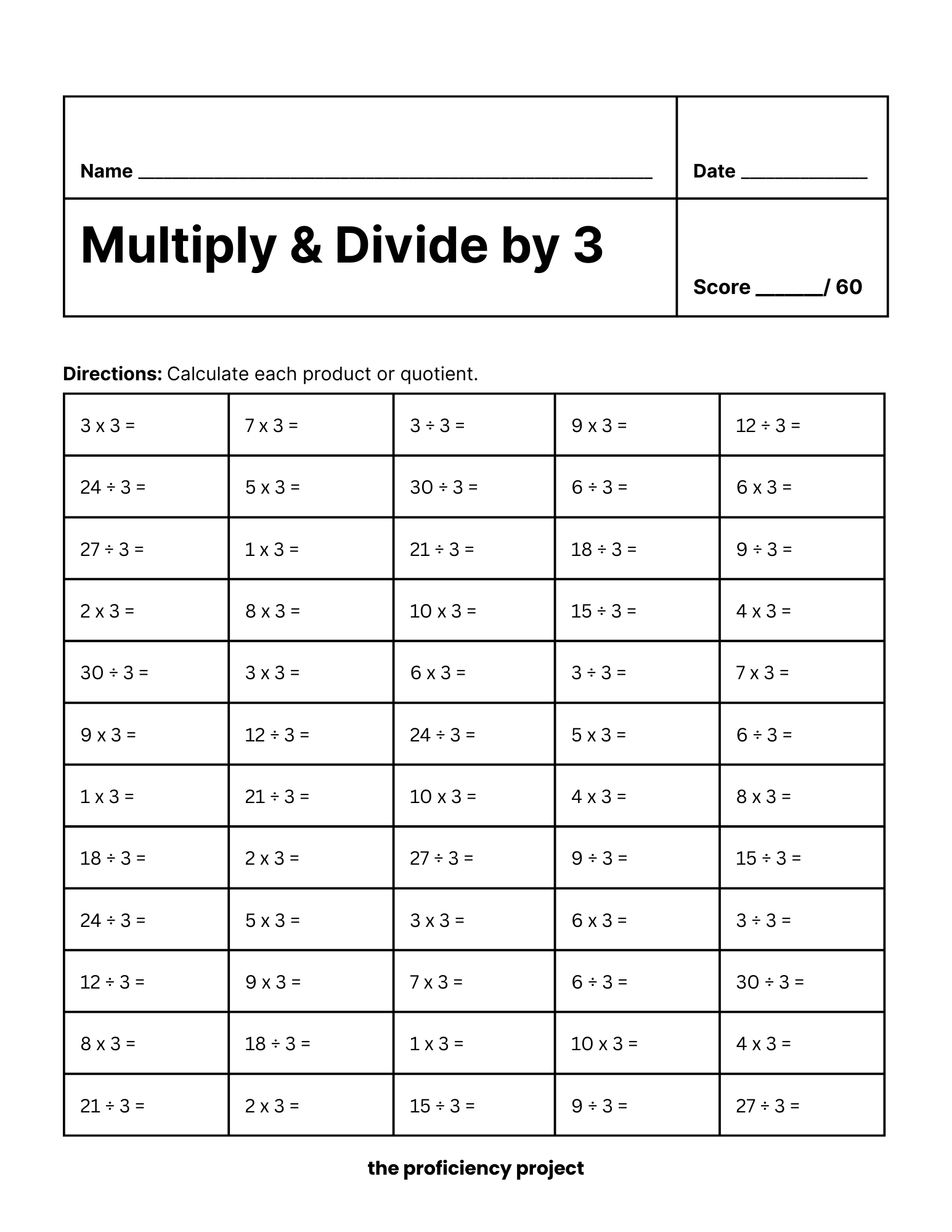
Students have 1-minute to answer as many questions as possible. Every week, they master a new fact family.
Frequently Asked Questions
Will timed activities cause math anxiety?
Timed drills become harmful when they are high-stakes, unpredictable, or punitive.
This routine is none of those.
It is daily and predictable
It is growth-based
It celebrates improvement
It is low stakes
When students experience structured success, timed retrieval builds confidence and processing speed, not fear.
Does this routine replace the math curriculum?
Not at all.
We believe that students should develop conceptual understanding of how the four operations work. For example, third grade students should learn what it means to multiply and divide using high-quality curriculum materials.
However, they should also have daily practice to memorize their multiplication and division facts.
How often should I do the routine?
The routine should be completed everyday.
What grade levels can complete this routine?
The routine is designed for grades 2-5 but can be implemented as whole group or small group intervention for middle grades.
Key Takeways
Fact fluency practice does not replace teaching math facts.
It reinforces them.
Five focused minutes per day:
Reduces cognitive load
Strengthens working memory efficiency
Predicts broader math performance
Builds confidence
Produces measurable growth
Automaticity is the foundation that allows deeper mathematics to happen.
Works Cited
Baker, A. T., & Cuevas, J. (2018). The importance of automaticity development in mathematics. Journal of Instructional Research, 7, 1–9. https://doi.org/10.9743/JIR.2018.1
Stickney, E. M., Sharp, J. M., & Kenyon, L. O. (2012). Experiences of elementary teachers implementing a math facts fluency intervention. Investigations in Mathematics Learning, 5(1), 1–23.
Woodward, J. (2006). Developing automaticity in multiplication facts: Integrating strategy instruction with timed practice drills. Learning Disability Quarterly, 29(4), 269–289. https://doi.org/10.2307/30035554
Hoboken Public School District. (n.d.). Math fact fluency: Everything you need to know. Hoboken Public Schools.
Illustrative Mathematics. (n.d.). Fluency development within and across the grades in IM K–5 Math™. https://illustrativemathematics.org
FactFreaks. (n.d.). 8 tips for teachers: Math fact fluency.
Sawchuk, S. (2024, August). Do timed tasks really worsen math anxiety? Education Week. https://www.edweek.org
