Skill Focus: Explicit Instruction
This post was originally shared on The Proficiency Project’s Substack.

Two weeks into the school year, our 3rd-8th grade math teachers are already seeing the impact of one simple component of our instructional framework: the Skill Focus Graphic Organizer (a variation of the Frayer Model).
A few years ago, our district adopted Illustrative Mathematics as our Tier 1 curriculum. While IM brought excitement and community to our classrooms, we noticed a problem: students often struggled to complete the lesson’s Activities and Cool Down.
Instead of experiencing productive struggle, they felt frustrated.
The excitement from the Warm-Up faded by the middle of the first activity because many lacked the background knowledge needed to solve problems in groups or independently.
Scaffold, But Don’t Reinvent the Wheel
We needed a scaffold to help support all students. The Frayer Model has been discussed online as a tool to support math learning for students with IEPs, English language learners, and students receiving interventions, so it seemed like a no-brainer to include it in our framework.
We added in a 10-minute teacher-led routine after the lesson’s Warm-Up activity to bridge the gap between engagement and success by giving students exactly what they need to access grade-level content.
The organizer is divided into four sections:
Definition / Formula
Procedure / Representation
Examples
Non-Examples (my 5th graders call this the “Do NOT Do This” box)
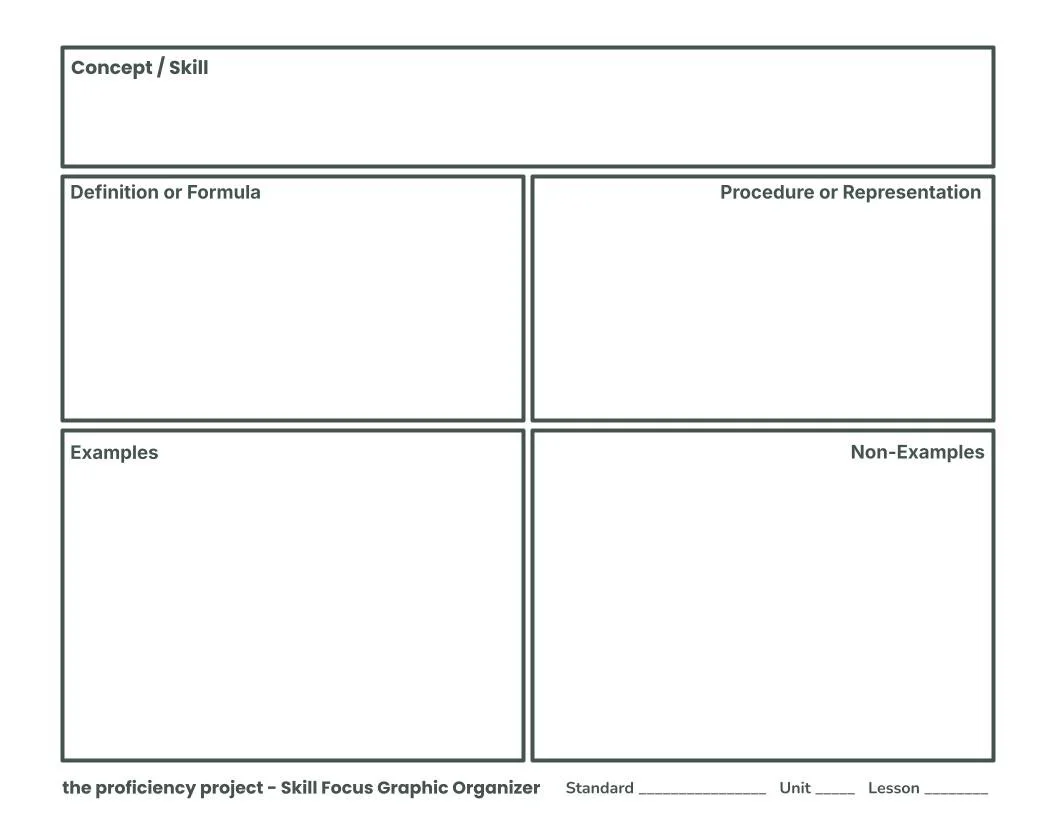
Planning the Skill Focus
Start by completing the Skill Focus Planning Guide. The planning guide will help you identify the skill or procedure that students need to access the lesson.
Review the standard and learning goal. Start with the Cool Down. Complete it yourself and connect it back to the priority standard.
Identify the skill or concept. Ask: What skill or concept can I teach explicitly so students can solve the Cool Down independently? Does it connect to the lesson’s standard and learning goal?
Plan the organizer.
Definition / Formula: Write a student-friendly definition or include the formula.
Procedure / Representation: Break the process into simple steps or clear visuals.
Examples: Demonstrate 1 or 2 sample problems that mirror the Cool Down.
Non-Examples: Highlight a common mistake to prevent future errors.
Teaching the Skill Focus
Teaching the Skill Focus serves two purposes:
It gives teachers a consistent routine to explicitly model and explain the concept or skill.
Provides a note-taking template students can reference during the Activities.
Preparation
Complete the Skill Focus Planning Guide (linked above)
Pre-fill the organizer with the examples and non-examples before class. If you’re teaching younger students or students with writing troubles, pre-fill the definition/formula and procedures/representation as well. Print a copy for each student.
Instruction - Even though you pre-filled a copy for students, start with an empty template and walk through each section with your class.
Name the concept or skill: Tell students exactly what you’re teaching them and write the title at the top of the template.
Definition / Formula: Introduce the concept by stating and writing a student friendly definition. If it is a procedure, you can introduce the formula. Encourage engagement by having students read it back to you.
Procedure / Representation: Walk through the student-friendly steps together. Make sure your steps are simple and easy to follow. Use call and response and other methods to encourage engagement and check for understanding.
Example(s): Use a think-aloud to model how to solve example problems while students listen. Make sure students aren’t copying notes or writing anything while you model (you need their full attention). Refer to the steps as you model to help students make the connection.
Non-Examples: Show a common misconception. Invite students to “catch the mistake” or offer their own (it builds confidence and reinforces accuracy). Reinforce the CORRECT way to do it by referring to the correct example and steps.
Final Thoughts
The Skill Focus Graphic Organizer has transformed how our students step into the Activities. Instead of fading after the Warm-Up, they are prepared and confident for the rest of the lesson.
By making space for explicit teaching, we set students up for real success inside a problem-based curriculum like Illustrative Math.
If you’d like to try the Skill Focus Organizer in your classroom, here’s what you need to get started:
